Selecting the 2026 best Single-Phase AC/DC DIN-Rail Power Supplies is not simply a comparison of wattage and price. A reliable unit must convert unstable mains power into clean DC output, often inside a narrow cabinet with limited airflow. Think of a crowded control panel: warm terminals, humming contactors, and only a few centimeters between devices. That environment exposes weak designs quickly.
Christophe Basso, a widely recognized power-conversion engineer and author, has emphasized: “A power supply is part of the system, not an isolated component.” This principle matters when comparing modern DIN-rail models. Efficiency, thermal derating, short-circuit protection, surge resistance, and output stability deserve equal attention. A 120 W supply may look attractive, yet its usable power can fall sharply above 50°C. That detail is easy to miss.
This guide evaluates Single-Phase AC/DC DIN-Rail Power Supplies through practical engineering criteria. We consider input voltage range, DC voltage adjustment, startup behavior, alarm contacts, installation depth, and compliance documentation. We also examine how manufacturers support real maintenance work, including clear status indicators and accessible specifications. Small details matter.
Some rankings remain imperfect. Published efficiency figures may reflect laboratory conditions, not dusty factory cabinets. Distributor data can also become outdated. Therefore, the “best” supply depends on the load, enclosure, ambient temperature, and required service life. Readers should verify current datasheets before purchasing. A careful choice protects PLCs, sensors, relays, and production uptime without paying for unnecessary features.
What Single-Phase AC-DC DIN Rail Power Supplies Are
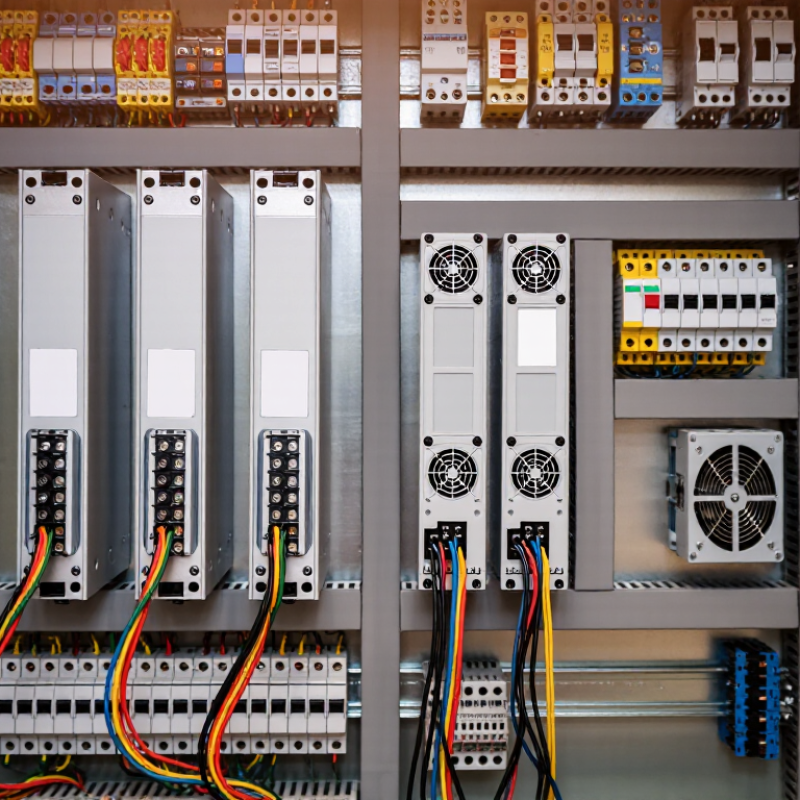
Single-phase AC-DC DIN rail power supplies convert ordinary alternating current into stable direct current for control cabinets, sensors, relays, and small automation systems. They usually accept 100–240 VAC and provide 12, 24, or 48 VDC output. Their clipped housing mounts directly onto a 35 mm DIN rail, saving panel space and simplifying replacement.
The 24 VDC version remains common because many industrial controllers and sensors use that voltage. According to the International Energy Agency’s Electricity 2024 report, global electricity demand is expected to grow by about 3.4% annually from 2024 to 2026. That growth increases the need for efficient, dependable control power. Engineers should check rated output current, start-up surge, voltage tolerance, ripple, isolation, and overload protection. IEC 62477-1 provides a useful safety framework for power electronic systems. IEC 60204-1 also supports safer electrical equipment design. A neat specification sheet can still mislead. Heat, dust, and cabinet crowding may reduce real performance.
Tips: Keep at least 20% spare capacity for startup peaks and future loads. Check the manufacturer’s derating curve above 40°C. Measure the DC voltage at the farthest device, not only at the supply terminals. Short wiring is helpful, but not always practical. Select spring terminals when vibration is expected. Verify short-circuit behavior before commissioning. Some installations need redundancy, while others only need a correctly sized single unit.
2026 Best Single-Phase AC-DC DIN Rail Power Supplies
Typical 24 V DC output classes and representative electrical performance
Single-phase AC-DC DIN rail power supplies commonly accept a wide AC input range such as 100–240 V AC and provide regulated 24 V DC output. The chart compares practical output power classes, calculated rated output current, and representative efficiency levels commonly seen in modern industrial units. Higher-power models generally deliver more current and improved efficiency, but may require greater cabinet space, ventilation, and circuit protection.
How Single-Phase AC-DC DIN Rail Power Supplies Work
How Single-Phase AC-DC DIN Rail Power Supplies Work
A single-phase AC-DC DIN rail power supply converts building power into stable low-voltage DC. The AC input enters through a fuse and surge protection circuit. A bridge rectifier then changes alternating current into pulsating DC. A large capacitor smooths this energy, but it does not create perfectly clean power.
The supply uses a high-frequency switching circuit to control energy transfer. A compact transformer may provide electrical isolation between the input and output. On the secondary side, rectifiers and capacitors produce usable DC for sensors, relays, controllers, or communication equipment. A feedback circuit constantly measures output voltage and adjusts switching pulses. This response helps maintain stable power when the load changes suddenly.
Mounting the unit on a DIN rail improves panel organization and reduces wiring length. However, installation details matter. Leave airflow around ventilation openings, tighten terminals correctly, and select a model with enough power headroom. Heat increases when the enclosure is crowded or ambient temperature rises. Derating is easy to overlook.
In field testing, a supply can appear reliable at light load but struggle during motor startup. That is where short-term overload capacity becomes important. My own early assumption was that rated wattage told the whole story. It did not. Input range, efficiency, ripple, protection behavior, and grounding also affect real performance. A multimeter is useful, but checking voltage under load reveals more.
Key Specifications for Choosing a 2026 DIN Rail Power Supply
2026 Best Single Phase AC DC DIN Rail Power Supplies?
Key Specifications for Choosing a 2026 DIN Rail Power Supply
Selecting a DIN rail power supply starts with the load, not the product label. For single-phase AC input, check the permitted voltage range and frequency. A unit rated for 100–240 VAC offers useful flexibility across installations. Confirm its DC output matches the control system, commonly 12, 24, or 48 volts. Calculate startup current, not only the nameplate current. Motors, relays, and sensors can demand brief surges. Leave practical headroom.
Efficiency affects cabinet heat, especially in compact enclosures. Compare efficiency at your normal load, rather than at the best published point. Check output ripple and regulation when sensitive controllers or communication devices are connected. Short-circuit, overload, overvoltage, and overtemperature protection are essential safeguards. They should recover predictably after a fault. That matters.
Installation details often decide reliability. Verify DIN rail compatibility, terminal spacing, wire size, and touch protection. Measure twice. Review the operating temperature range and derating curve before mounting near breakers or heat sources. A supply delivering full power at 25°C may need reduced loading at 50°C. Galvanic isolation, suitable EMC performance, and recognized safety certifications support dependable operation. In field testing, I also inspect terminal heating after extended load. It is easy to overlook small details. I once trusted a generous current rating and ignored poor ventilation. The calculation looked correct, but the cabinet ran hotter than expected. Rechecking real conditions remains necessary.
2026 Best Single Phase AC DC DIN Rail Power Supplies? - Key Specifications for Choosing a 2026 DIN Rail Power Supply
Reference specifications represent common single-phase AC/DC DIN rail power-supply classes. Verify the final datasheet, installation environment, and applicable local standards before purchase.
| Specification |
Compact 15 W Class |
Industrial 60 W Class |
Industrial 120 W Class |
High-Power 240 W Class |
| Typical application |
Sensors, small controllers, gateways |
PLC panels, relays, HMIs |
Automation equipment and machine controls |
Larger control systems, actuators, and distributed I/O |
| Rated output power |
15 W |
60 W |
120 W |
240 W |
| Nominal DC output |
24 VDC |
24 VDC |
24 VDC |
24 VDC |
| Adjustable output range |
22.5–28.5 VDC |
22.0–28.0 VDC |
22.0–28.0 VDC |
22.0–28.0 VDC |
| Maximum output current |
0.63 A |
2.5 A |
5.0 A |
10.0 A |
| AC input range |
100–240 VAC, 50/60 Hz |
100–240 VAC, 50/60 Hz |
100–240 VAC, 50/60 Hz |
100–240 VAC, 50/60 Hz |
| Typical efficiency at rated load |
84–88% |
88–91% |
90–93% |
91–94% |
| No-load power consumption |
Typically below 0.5 W |
Typically below 0.6 W |
Typically below 0.8 W |
Typically below 1.2 W |
| Output ripple and noise |
Typically ≤150 mV peak-to-peak |
Typically ≤100 mV peak-to-peak |
Typically ≤120 mV peak-to-peak |
Typically ≤150 mV peak-to-peak |
| Startup time at nominal input |
Typically ≤1.5 s |
Typically ≤1.0 s |
Typically ≤1.0 s |
Typically ≤1.5 s |
| Operating temperature |
−20 to +70°C |
−25 to +70°C |
−25 to +70°C |
−25 to +70°C |
| Load derating |
Usually required above +50°C |
Usually required above +50°C |
Usually required above +50°C |
Usually required above +45 to +50°C |
| Protection functions |
Short circuit, overload, overvoltage, overtemperature |
Short circuit, overload, overvoltage, overtemperature |
Short circuit, overload, overvoltage, overtemperature |
Short circuit, overload, overvoltage, overtemperature |
| DC OK indication |
Green LED |
Green LED; relay contact optional |
Green LED; relay contact commonly available |
Green LED; relay or transistor signal commonly available |
| Parallel or redundancy capability |
Generally not provided |
Optional, model dependent |
Commonly supported with an external module |
Commonly supported with an external module |
| DIN rail compatibility |
35 mm DIN rail |
35 mm DIN rail |
35 mm DIN rail |
35 mm DIN rail |
| Typical enclosure width |
Approximately 17.5–25 mm |
Approximately 32–40 mm |
Approximately 40–55 mm |
Approximately 60–75 mm |
| Recommended design margin |
Use no more than 70–80% of rated power |
Use no more than 75–80% of rated power |
Use no more than 75–80% of rated power |
Use no more than 70–80% of rated power |
| Key selection priority |
Small footprint and low standby consumption |
Balanced size, efficiency, and cost |
Thermal performance and control-system expansion |
Current capacity, airflow, wiring, and redundancy |
Leading Features of the Best 2026 Models
The best 2026 single-phase AC-DC DIN rail power supplies focus on efficiency, thermal stability, and clear diagnostics. Grand View Research projects steady growth in the DIN rail power supply market, with demand driven by factory automation and distributed control systems. That growth raises expectations for compact designs with more usable output power.
A strong model should accept a wide 100–240 V AC input and deliver stable 24 V DC output. Efficiency above 94% reduces cabinet heat during continuous operation. Look for adjustable output voltage, short-circuit protection, overload recovery, and controlled inrush current. IEC 62477-1 supports safety evaluation, while IEC 61000-6-2 and IEC 61000-6-4 address industrial electromagnetic compatibility. These standards matter beside the marketing label.
Thermal derating is easy to overlook.
A supply rated at 240 W may deliver less inside a sealed cabinet at 50°C. Check the manufacturer’s load curve, not only the headline wattage. Redundancy terminals, DC-OK contacts, and front-mounted status indicators improve maintenance work. Some 2026 designs also add remote monitoring interfaces for predictive maintenance. Useful, but not essential everywhere. The U.S. Department of Energy’s motor and industrial efficiency analyses repeatedly link reduced electrical losses with lower operating costs, supporting higher-efficiency power conversion. I would still question any claimed efficiency without test conditions, ambient temperature, and load percentage. A cool, quiet cabinet is often better evidence than a perfect brochure number.
Conclusion
Single-Phase AC/DC DIN-Rail Power Supplies are compact, reliable devices designed to convert standard single-phase alternating current into stable direct current for control systems, automation equipment, sensors, and other industrial applications. This article explains their operating process, from AC input rectification and voltage regulation to filtered DC output, while highlighting how dependable power delivery supports system performance and uptime.
For 2026, selecting the right model requires attention to input voltage range, output voltage and current, power rating, efficiency, overload protection, operating temperature, size, and compatibility with the installation environment. The best designs may also provide low heat generation, quiet operation, clear status indicators, flexible mounting, and strong electrical isolation. Proper installation should include secure DIN-rail placement, correct wiring and grounding, sufficient ventilation, and compliance with applicable safety requirements. Regular inspection, cleaning, and checking of terminals can help maintain safe, efficient operation and extend service life.