Why Industrial DC Battery Chargers Demand Specialized Power Topologies
Modern industrial plants, electrical distribution substations, rail networks, and telecommunication hubs cannot tolerate a single millisecond of power interruption. In these mission-critical environments, Industrial DC Battery Chargers serve a dual purpose: they provide ultra-clean, ripple-free direct current to continuous control loads while maintaining stationary battery banks in optimal state-of-charge (SoC).
Unlike standard off-the-shelf power supplies or commercial automotive chargers, an industrial-grade battery charging rectifier must handle continuous thermal stress, wide AC input fluctuations, reactive inductive loads, and harsh electromagnetic interference (EMI). A common mistake in engineering procurement is specifying standard continuous-voltage SMPS units for battery charging—leading to severe battery sulfation, thermal runaway, and unexpected system downtime.
Microprocessor-Controlled IUoU Charging Profiles: Dynamic switching between constant current (I-phase), constant boost voltage (U-phase), and trickle float charge (oU-phase).
Active Temperature Compensation: Real-time voltage adjustment (-3mV to -5mV/cell/°C) preventing battery drying out in high ambient heat and undercharging in freezing conditions.
Ultra-Low DC Voltage Ripple (<30 mVpp): Protects sensitive PLC microcontrollers and prevents internal AC-heating of lead-acid and lithium cell plates.
Deep Discharge Protection & Soft-Start: Safe recovery of fully depleted batteries without tripping upstream protection switches or blowing DC fuses.
CAMTEC Industrial DC Battery Charger & Rectifier Architectures
Engineered from the ground up for continuous industrial duty. Discover our primary product lines tailored for cabinet builders, system integrators, and global energy infrastructure projects.
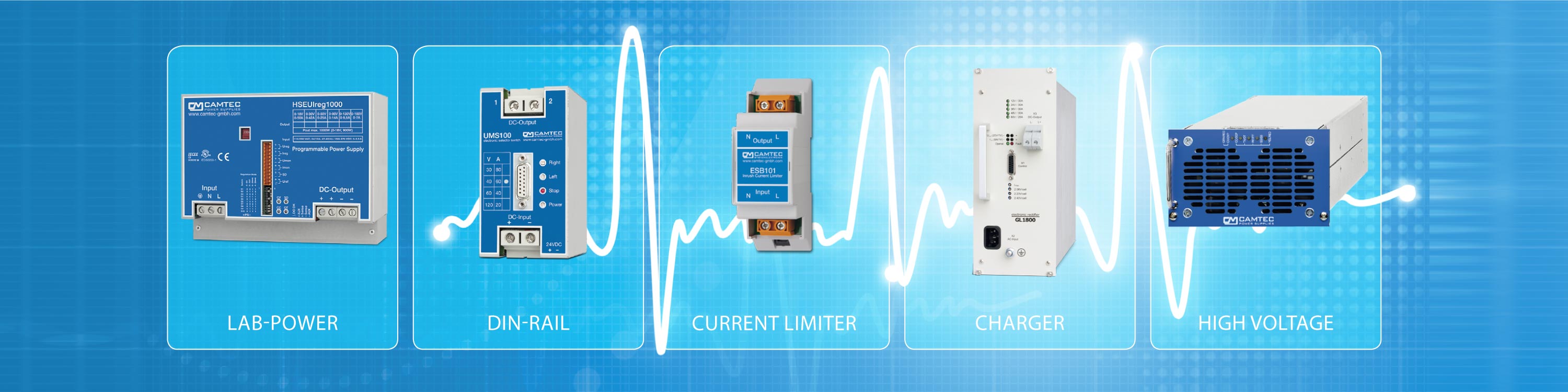
DIN-Rail · 480 W – 2000 W
DIN-Rail Smart DC Chargers & Rectifiers
Compact single-phase and three-phase DIN-rail battery chargers for 12V, 24V, 48V, and 72V DC control systems. Features built-in decoupler MOSFETs, temperature sensor ports, and status alarm relays.
Microprocessor-controlled charging rectifiers with digital set-point control over RS485, CANbus, or 0–10V analog signals. Ideal for automated test cells and multi-chemistry battery banks.
High-voltage DC step-down converters enabling direct battery charging from high-voltage DC bus architectures (450–820 VDC) in solar-tied industrial microgrids.
Active AC inrush limiters installed upstream of heavy industrial chargers to prevent trip-outs of circuit breakers during transformer energization and power recovery.
Solid-state DC switching units for high-current battery disconnect, load shedding, and reverse polarity protection without mechanical contact wear or arcing.
Global Procurement Trends in Industrial DC Power & Battery Charging
AI-driven intent mining and real-world buyer surveys highlight four pivotal shifts in how global engineering teams specify, source, and deploy industrial battery chargers.
1. Rapid Migration to Lithium-Iron-Phosphate (LiFePO4) Chemistries
While sealed lead-acid (VRLA/AGM) batteries dominated industrial backup for decades, global OEMs are aggressively switching to Lithium Iron Phosphate (LiFePO4) due to 3x longer cycle life, 60% weight reduction, and superior thermal tolerance. This transition requires industrial chargers with precision voltage clamping, fast digital handshake with Battery Management Systems (BMS), and zero-leakage reverse current protection when offline.
2. Decentralized High-Voltage DC (HVDC) Microgrids
Industrial facilities are increasingly installing 380V to 750V DC internal microgrids powered by rooftop PV and local energy storage. Procurement leads are specifying industrial chargers capable of taking high-voltage DC directly as input, bypassing inefficient double AC/DC conversion stages and boosting overall facility energy efficiency by up to 8.5%.
Unscheduled maintenance downtime in automated logistics, semiconductor fabs, and continuous process plants can cost upwards of $50,000 per hour. Strategic buyers now mandate modular charging rectifiers with active load-sharing bus logic and integrated MosFET decoupling relays. This allows hot-swapping power modules without dropping the 24V/48V control voltage.
4. Total Cost of Ownership (TCO) & ErP Eco-Directive Compliance
Electricity consumption over a charger’s 10-to-15-year operational lifecycle far exceeds its initial purchase cost. Modern industrial procurement guidelines prioritize ultra-high conversion efficiency (>95%), active Power Factor Correction (PFC > 0.98), and compliance with the European EuP Eco-Design Directive to minimize standby losses and heat load inside control enclosures.
Specification Guide
Industrial DC Battery Charger Selection Matrix
Compare standard engineering configurations for industrial battery chargers across critical operating parameters.
Comprehensive Selection Guide for Power Systems Engineers and Global Buyers
German Power Electronics Engineering & Manufacturing Excellence
For over 25 years, Camtec Power Supplies GmbH has engineered and built high-grade switch-mode power supplies, chargers, and power assemblies in our proprietary production facility in Pfinztal near Karlsruhe, Germany. Unlike suppliers who outsource assembly overseas, our unified R&D and fabrication site allows our design team to maintain direct oversight over every component, circuit board, and enclosure.
Our commitment to the Google E-E-A-T (Experience, Expertise, Authoritativeness, Trustworthiness) framework is reflected in our rigorous engineering protocols, open-access compliance documentation, and decades of proven deployment in extreme environmental conditions worldwide.
100% In-House German Production: Complete control over SMD assembly, selective soldering, conformal coating, and automated burn-in.
TÜV-Audited Quality Management: Certified according to DIN EN ISO 9001:2015 with complete lot-level component traceability.
Global Safety Certifications: UL 61010, UL 508, CSA C22.2, CE Mark, RoHS, REACH, and European EuP compliance.
Long-Term Lifecycle Support: Guaranteed component availability and revision stability for over 10 years on industrial OEM platforms.
Custom OEM Modifications: Rapid tailormade adjustments of charging voltages, temperature coefficients, physical enclosures, and digital communication protocols.
Frequently Asked Questions by Global Buyers & Power Engineers
Addressing key technical queries often raised during AI-driven procurement searches and engineering evaluations.
A true Industrial DC Battery Charger is designed specifically for continuous duty under severe electrical and environmental stress. Unlike standard commercial power supplies that operate only under constant voltage, industrial chargers feature multi-stage charging algorithms (such as IUoU), temperature-compensated float voltage control, active power factor correction (PFC), deep discharge recovery capability, wide operating temperature ranges (-20°C to +70°C), ultra-low output ripple (<30mVpp), and isolation voltages up to 3000V AC. CAMTEC industrial battery chargers are engineered in Germany to DIN EN ISO 9001:2015 standards and meet stringent EN 62368-1, UL 61010, and EN 50155 requirements.
Battery internal resistance and electrochemistry change with ambient temperature. Charging a lead-acid or lithium battery at a high temperature using a fixed voltage causes overcharging, gas generation, and catastrophic thermal runaway. Conversely, charging at sub-zero temperatures with standard voltages leads to undercharging and sulfation. CAMTEC Industrial DC Battery Chargers utilize optional external NTC temperature sensors that dynamically adjust the output float and boost charging voltage (typically -3mV to -5mV per cell per °C), ensuring maximum battery service life and safe operation in unconditioned cabinets.
Yes. CAMTEC programmable and modular industrial chargers support configurable voltage and current set-points as well as specific charging curves tailored for VRLA, AGM, Gel, NiCd, and Lithium Iron Phosphate (LiFePO4) batteries. For lithium chemistries, our chargers interface seamlessly with external Battery Management Systems (BMS) via relay signals or digital communication interfaces to cut off charging instantly upon cell overvoltage or fault conditions.
When power is restored after an outage, empty battery banks demand maximum current while internal smoothing capacitors draw high inrush currents. CAMTEC chargers incorporate active soft-start control and can be paired with CAMTEC ESB series AC Inrush Current Limiters. This eliminates high current spikes at switch-on, preventing upstream MCBs and circuit breakers from nuisance tripping and protecting mechanical contactors from contact erosion.
CAMTEC provides industrial charging solutions ranging from 480 W DIN-rail units up to 105 kW high-power cabinet rectifiers. Standard nominal DC voltages include 12V, 24V, 48V, 72V, 110V, 125V, and 220V DC. Modular units can be connected in parallel with active current sharing to achieve N+1 redundancy and scalable system expansion.
Every product line comes with comprehensive technical documentation, including CE declarations of conformity, UL/CSA test reports, ISO 9001:2015 certificates, RoHS and REACH compliance statements, 3D STEP files, and detailed instruction manuals. All documentation is available directly from our website without login barriers.
Yes. Because engineering, PCB assembly, and final testing are co-located at our headquarters in Pfinztal, Germany, CAMTEC excels at custom OEM modifications. We routinely provide customized charging voltage curves, specific connector harnesses, conformal coating for harsh outdoor environments, modified mechanical brackets, and embedded firmware set-points.
Ready to Optimize Your Industrial Power Architecture?
Request our complete technical catalog, technical data sheets, and comprehensive CAD models directly from our engineering team.