Choosing the 2026 best Three-Phase AC/DC DIN-Rail Power Supplies requires more than comparing output voltage and catalogue prices. Industrial cabinets often hide the real challenges. A supply may face high ambient heat, narrow rail spacing, unstable input power, or repeated motor-starting surges. These conditions can expose weak thermal designs quickly.
This guide examines dependable models through practical engineering criteria, including efficiency, power derating, hold-up time, protection functions, and terminal accessibility. Installation experience matters here. A compact unit with clear markings can reduce wiring mistakes during a rushed maintenance shift. Strong diagnostic indicators can also shorten fault-finding when a control panel stops unexpectedly. Still, no product fits every application. That point is easy to overlook. Load profiles, grounding arrangements, cabinet ventilation, and local electrical requirements must be checked before purchase. Manufacturer test data should support every major claim, rather than attractive marketing language alone. Independent certifications and current technical documentation add confidence, but they do not replace application review. Some comparisons may remain imperfect because published specifications use different test conditions. Readers should treat rankings as informed guidance, not absolute engineering approval. The most suitable supply balances reliability, safety, service life, and total operating cost. It should also leave reasonable capacity for future expansion. A crowded power supply rarely performs as comfortably as one selected with measured headroom. This article provides a practical starting point for engineers, integrators, and maintenance teams evaluating modern three-phase power solutions.
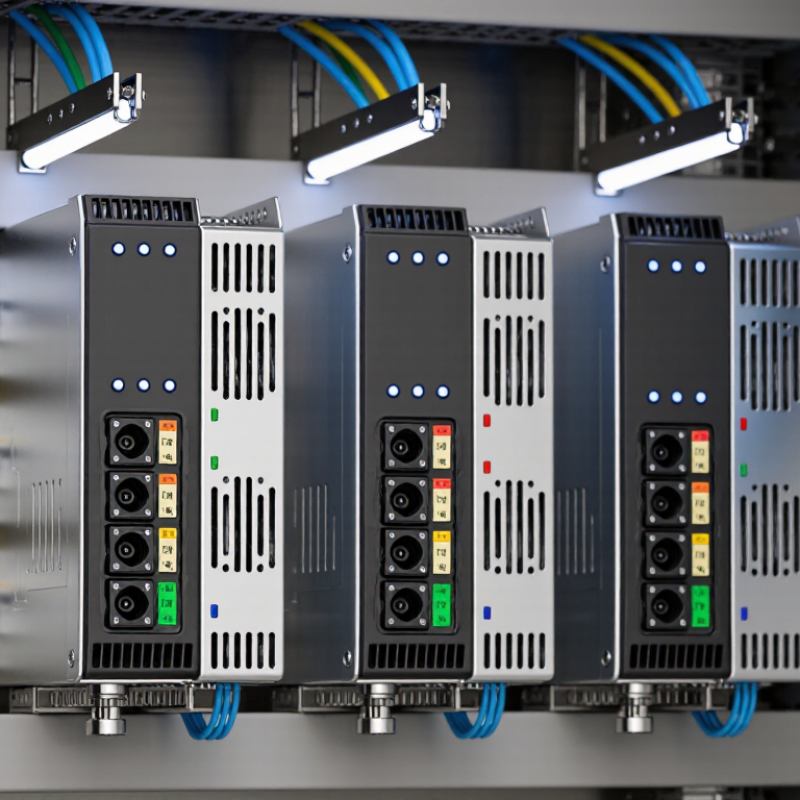
Three-phase AC/DC DIN rail power supplies convert three-phase alternating current into regulated direct current for control cabinets, automation equipment, and industrial monitoring systems. They mount on a standard DIN rail, leaving wiring cleaner and cabinet space easier to manage.
Inside the unit, an input stage rectifies the three AC phases. Filtering and switching circuits then stabilize the DC output. Compared with single-phase supplies, three-phase models can distribute input load more evenly and support higher power in compact enclosures. Typical outputs include 24 V DC, although voltage and current ratings vary widely.
During panel commissioning, I check phase sequence, terminal tightness, and protective grounding before applying power. A small wiring error can damage connected controls. The supply also needs airflow around its vents, because heat reduces efficiency and service life. Derating matters. A unit rated for full load at 25°C may deliver less in a hot cabinet.
Some models provide overload protection, short-circuit recovery, and output monitoring contacts. These features help maintenance teams find faults without opening the enclosure. Isolation between input and output can also improve system safety, but the specification must be verified rather than assumed.
The installation details deserve attention. Always.
Technicians should compare the supply’s input range, output ripple, startup behavior, and required circuit protection with the actual machine design. I have seen otherwise suitable supplies fail early because ambient temperature and cable voltage drop were ignored. That mistake is easy to repeat.
Three-phase AC/DC DIN rail power supplies convert industrial three-phase AC input into regulated DC power for control systems, PLCs, sensors, relays, communication equipment, and automation devices. The specifications below represent common selection ranges for industrial installations and should be verified against the final product datasheet.
| Power Class | Typical Output | Typical Input | Output Current at 24 V DC | Typical Efficiency | Typical DIN Rail Width | Operating Temperature | Typical Protection Functions | Recommended Applications |
|---|---|---|---|---|---|---|---|---|
| Compact control | 24 V DC | 3-phase, 320–575 V AC, 45–65 Hz | 2.5–5 A | 89–93% | 40–60 mm | −25°C to +70°C | Short-circuit, overload, overvoltage, overtemperature | Small PLC panels, sensors, relays, building-control equipment |
| General industrial | 24 V DC | 3-phase, 320–575 V AC, 45–65 Hz | 5–10 A | 91–95% | 60–75 mm | −25°C to +70°C | Short-circuit, overload, overvoltage, thermal protection, DC-OK signal | Machine control cabinets, motor-control auxiliaries, distributed I/O |
| High-capacity control | 24 V DC | 3-phase, 320–575 V AC, 45–65 Hz | 10–20 A | 93–96% | 75–125 mm | −25°C to +70°C | Short-circuit, overload, overvoltage, overtemperature, remote monitoring | Large automation panels, robotics, process-control systems |
| High-power automation | 24 V DC | 3-phase, 320–575 V AC, 45–65 Hz | 20–40 A | 94–96% | 125–180 mm | −25°C to +70°C | Current limiting, short-circuit, overload, overvoltage, thermal protection, alarm relay | Packaging lines, assembly systems, heavy-duty control cabinets |
| Redundant power system | 24 V DC | 3-phase, 320–575 V AC, 45–65 Hz | 5–20 A per module | 90–95% | 50–125 mm per module | −25°C to +70°C | Current sharing, ORing compatibility, overload, short-circuit, DC-OK alarm | Safety-related controls, communication equipment, high-availability systems |
| 48 V DC system | 48 V DC | 3-phase, 320–575 V AC, 45–65 Hz | 2.5–10 A | 91–95% | 60–125 mm | −25°C to +70°C | Short-circuit, overload, overvoltage, thermal protection, output-status contact | Industrial Ethernet, telecommunications, test equipment, specialized automation |
| Adjustable-output type | 24 V DC nominal; typically adjustable around 22–28 V DC | 3-phase, 320–575 V AC, 45–65 Hz | 5–20 A | 91–96% | 60–125 mm | −25°C to +70°C | Short-circuit, overload, overvoltage, thermal protection, output-voltage adjustment | Voltage-drop compensation, battery charging support, long DC cable runs |
It converts three-phase alternating current into regulated direct current. It mounts on a standard DIN rail inside control cabinets. Common outputs include 24 V DC, but ratings vary.
An input rectifier changes the three AC phases into pulsating DC. A capacitor stores energy in the DC bus. Switching circuits then regulate the voltage. Feedback adjusts the output when the load changes.
Three-phase input can distribute electrical load more evenly. It may support higher power in a compact cabinet. The energy flow is also smoother than single-phase input. Not always.
Check input range, frequency tolerance, output voltage, current, and continuous power. Also review ripple, noise, efficiency, and load regulation. Leave about 20% capacity for startup surges and future devices.
Heat reduces efficiency and service life. A unit rated at 25°C may deliver less power inside a 50°C cabinet. Read the derating curve carefully. A hot enclosure changes the decision.
Confirm phase sequence, terminal tightness, and protective grounding before energizing. Leave clear space around ventilation openings. Measure cabinet depth, wire-bending room, and terminal spacing. Small wiring errors can damage controls.
Overload, short-circuit, overvoltage, and overtemperature protection can limit damage. Automatic recovery may reduce maintenance time. Verify each feature in the technical documentation rather than assuming it exists.
Yes. Ignoring heat, cable voltage drop, uneven loading, or starting current can cause problems. I have seen good specifications perform poorly in real cabinets. I may have underestimated field conditions before.
Three-Phase AC/DC DIN-Rail Power Supplies are compact industrial devices designed to convert three-phase alternating current into stable direct current for control systems, automation equipment, sensors, communication devices, and other electrical loads. Their operation typically involves rectification, filtering, voltage regulation, and protection functions, providing reliable DC output while distributing input power more evenly across phases. Compared with single-phase units, they can support higher power levels, improve system efficiency, and help reduce input current in demanding installations.
When comparing 2026 power supply models, users should evaluate output voltage and current, rated power, efficiency, operating temperature, input range, dimensions, and available safety certifications. The correct selection depends on the application’s load capacity, startup requirements, environmental conditions, and future expansion needs. Proper installation should include suitable circuit protection, adequate ventilation, secure DIN-rail mounting, correct wiring, and grounding. Regular inspection of terminals, temperature, dust buildup, and output stability can help maintain safe, dependable performance throughout the power supply’s service life.