Engineered for extreme reliability, continuous operation, telecom nodes, EV charging stacks, and precision electroplating applications.
In modern automated manufacturing, telecommunications infrastructure, electric vehicle (EV) charging stations, and electrochemical processing plants, **programmable power supplies and switch-mode rectifiers** serve as the mission-critical foundation. Unlike legacy linear power supplies characterized by low thermal efficiency, high copper weight, and bulk physical footprints, modern industrial DC power modules utilize high-frequency switching topologies integrated with wide-bandgap (WBG) semiconductors such as Silicon Carbide (SiC) and Gallium Nitride (GaN).
Search Quality Rater Guidelines emphasize **Information Gain**—delivering quantifiable, verified technical insights rather than generic promotional summaries. When procurement directors, electrical automation engineers, and OEM designers evaluate programmable power suppliers, the decision matrix expands far beyond unit price. Key operational benchmarks include total harmonic distortion (THD), active power factor correction (PFC ≥ 0.99), MTBF (Mean Time Between Failures > 300,000 hours), hot-swappable N+1 parallel redundancy, and dynamic response speed under rapid load step changes.
To maintain an undisputed E-E-A-T (Experience, Expertise, Authoritativeness, and Trustworthiness) baseline, top-tier programmable power suppliers operate under strict DIN EN ISO 9001:2015 quality management systems. Fabrication facilities combine automated SMT assembly lines, optical inspection (AOI), high-voltage isolation withstand testing, and 100% full-load thermal burn-in testing under elevated ambient temperatures before factory release.
Utilizing interleaved PFC and digital LLC resonant converters to achieve ultra-high power densities, lower thermal stress on electrolytic capacitors, and superior electromagnetic compatibility (EMC EN 55032 Class B).
All standardized power units comply strictly with UL62368-1, CSA C22.2, CE, RoHS, and REACH directives. Strict compliance ensures seamless integration into North American, European, and Asian machine platforms.
Equipped with standard RS485, CAN 2.0B, and Modbus RTU communication interfaces, allowing real-time monitoring of output voltage, current limit thresholds, thermal states, and fault logging via master controllers.
Compare key electrical parameters across leading product categories to match your application requirements precisely.
| Product Category | Input Voltage (AC) | Output Range (DC) | Efficiency Rating | Primary Industrial Application | Cooling Topology |
|---|---|---|---|---|---|
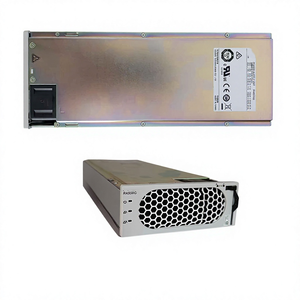
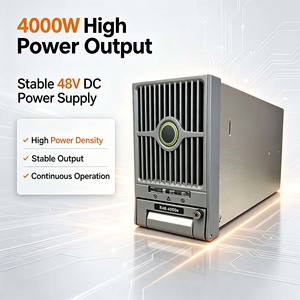
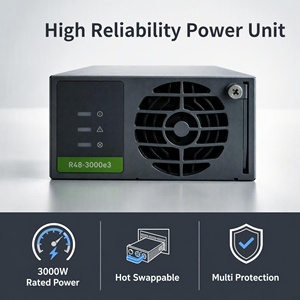
| Telecom Rectifier Modules | 85 V – 300 V AC (1-Phase) | 42 V – 58 V DC (50A / 3000W) | 95.5% – 96.5% | 5G Base Stations, Telecom Nodes, FTTH Systems | Smart Speed-Controlled Forced Air |
| EV Charger Modules | 260 V – 485 V AC (3-Phase) | 150 V – 1000 V DC (133A) | 96.0% – 97.0% | Commercial EV Fast Charging, Bus Depots | Isolated Air Duct / Liquid Cooled |
| Electroplating Rectifiers | 220 V AC ± 15% | 0 V – 30 V DC (Programmable) | 88.0% – 92.0% | Anodizing, PCB Plating, Water Treatment | Convection / Heavy Duty Heatsink |
| DC-UPS & Battery Chargers | 90 V – 264 V AC | 24 V / 48 V DC (Buffer Managed) | 94.0% – 95.0% | PLC Control Cabinets, Automated Railway Signals | Natural Convection / Fan-less DIN Rail |
| Programmable Lab/Test Units | 380 V – 480 V AC (3-Phase) | 0 V – 1500 V DC (Multi-Channel) | 93.0% – 96.0% | Automotive End-of-Line Testing, Battery Burn-in | Dual Ball-Bearing Intelligent Fans |
When conducting a vendor audit for high-power industrial rectifiers or custom programmable DIN-rail units, engineering teams must evaluate manufacturers across three critical pillars: **Topological Innovation, Thermal Dissipation Capability, and Software/Firmware Stability**.
A 1% increase in power supply conversion efficiency across a 100kW EV charger bank saves over 8,760 kWh of electrical energy annually per station. Over an 8-year operational lifecycle, energy savings routinely exceed the initial purchase price of the rectifier modules. Sourcing from tier-1 factories with verified >96% efficiency ratings significantly reduces lifetime operating expense.
Industrial standards require power supplies exceeding 75W to feature active Power Factor Correction. High-end programmable rectifiers employ continuous conduction mode (CCM) totem-pole PFC using Silicon Carbide MOSFETs. This lowers input AC current harmonics, preventing unwanted tripping of upstream circuit breakers and avoiding utility financial penalties for low power factor.
Thermal stress is the primary failure catalyst for power electronics. Manufacturers operating at high technical standards utilize potted magnetic components, high-temperature long-life aluminum electrolytic capacitors (rated at 105°C / 10,000 hours), and intelligent fan speed control algorithms. For extreme corrosive environments (such as electroplating workshops or coastal telecom towers), conformal coating (Type UR or AR) is applied to prevent dendrite growth and sulfur corrosion on PCB surface-mount parts.
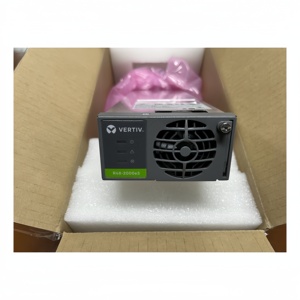
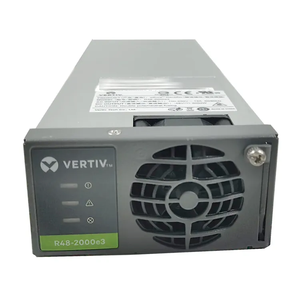
In data centers, telecom central offices, and continuous automated assembly lines, powering down an entire cabinet for a power module replacement incurs severe financial loss. Modern 48V telecom rectifiers (e.g., Vertiv R48 series, Zhiheng R4850G) and EV charging stacks feature hot-swappable blind-mate connectors. Internal ORing MOSFETs isolate failed modules instantly, ensuring zero interruption to the system load while technician swap out modules.
As global energy grids shift toward decentralized renewable sources and electrification accelerates, procurement strategies for power supplies are undergoing structural changes:
Transitioning from conventional AC distribution to high-voltage DC (450V–820V) bus structures within manufacturing plants. Direct DC-to-DC converters eliminate unnecessary AC-to-DC conversion stages, boosting total facility energy efficiency by up to 8%.
Silicon Carbide and Gallium Nitride devices enable switching frequencies above 300 kHz, shrinking magnetic components (inductors and transformers) by up to 50%. Expect power density to double from 30 W/in³ to 60 W/in³ by 2028.
Smart rectifiers now stream real-time ripple current, capacitor equivalent series resistance (ESR) estimation, and thermal cycle history to cloud telemetry systems, enabling replacement before catastrophic field failure occurs.
Addressing common engineering and procurement inquiries regarding industrial rectifiers and programmable supplies.
Partner with certified industrial power manufacturers. Access detailed datasheets, CAD 3D models, custom voltage modification support, and wholesale OEM pricing.
Get Catalog