Explore top-grade industrial switch-mode rectifiers, telecom power modules, electroplating rectifiers, and high-frequency DC charging stages equipped with real-time current telemetry and overcurrent protection.
Modern industrial electronics require hyper-accurate current monitoring, seamless power conversion, and uninterrupted direct-current (DC) delivery. As global manufacturing scales toward Industry 4.0, the synthesis of closed-loop current sensors, high-frequency AC/DC switched-mode power supplies (SMPS), telecom rectifiers, and solid-state MosFET switching infrastructure forms the bedrock of operational reliability.
Purchasing directors and chief power system architects face an increasingly complex sourcing landscape. Sourcing from verified current sensor factories and power rectifier exporters requires an analytical evaluation beyond superficial price-per-watt metrics. High-power applications—such as 40kW EV supercharging stations, telecommunications 48V node cabinets, electroplating power modules, and smart factory DIN-rail networks—demand precise thermal stability, minimal Total Harmonic Distortion (THD), robust Electromagnetic Compatibility (EMC), and galvanic isolation up to several kilovolts.
At the center of this technological paradigm shift is the integrated current sensor. Whether utilizing Hall-effect principles, shunt resistors with isolated delta-sigma modulators, or Rogowski coils for transient waveform sampling, integrated telemetry inside rectifiers enables real-time feedback loops. This facilitates predictive maintenance, dynamic load balance, and rapid short-circuit protection in sub-millisecond timeframes.
Engineering excellence, strict quality assurance protocols, and fully traceable component selection establish long-term reliability across demanding industrial environments.
Every industrial power supply, DIN-rail converter, and high-capacity rectifier module undergoes rigorous design verification testing (DVT). Manufacturing facilities operated under strict DIN EN ISO 9001:2015 specifications ensure 100% full-load burn-in testing and comprehensive batch traceability for zero-defect compliance.
Utilizing advanced synchronous rectification and Wide-Bandgap (WBG) materials such as Silicon Carbide (SiC) and Gallium Nitride (GaN), current modules achieve up to 96.5% efficiency. Advanced planar transformers and custom heatsink designs provide extended thermal margins under continuous duty cycles.
Replacing traditional electromechanical relays with UMS wearless electronic DC MosFET relays eliminates arc generation, contact erosion, and acoustic noise. Designed for millions of continuous operation cycles in high-vibration railway and robotics systems.
High capacitive loads in power supplies often trigger upstream circuit breaker tripping during initial power-up. Integrated ESB active inrush current limiters safely control capacitive charging ramps, enabling smooth startup without oversized breakers.
Products are globally certified to UL, CSA, CE, RoHS, and REACH standards, meeting stringent electromagnetic compatibility guidelines (EN 55032 Class B) and safety directives (IEC/EN 62368-1) required by North American and European procurement authorities.
Direct factory access allows custom modification of output voltage setpoints, conformal PCB coatings for high-humidity environments, specialized terminal block pinouts, and custom firmware profiles for programmable test automation setups.
Selecting the optimal power supply or rectifier module requires matching systemic requirements against key topology parameters. Below is an engineering overview of leading platforms:
| Application Scenario | Recommended Module Topology | Current Sensing Method | Power Range | Primary Technical Advantage |
|---|---|---|---|---|
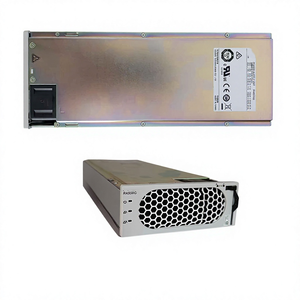
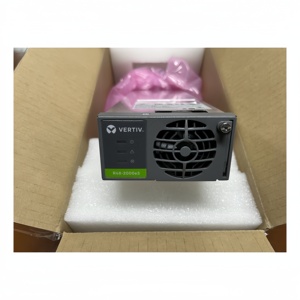
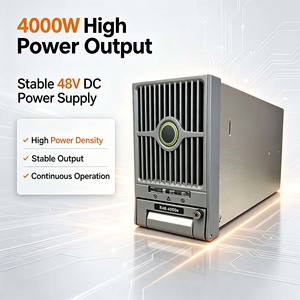
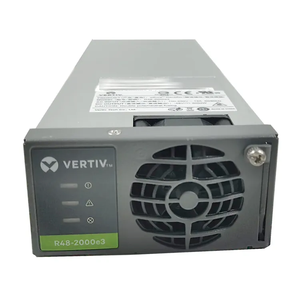
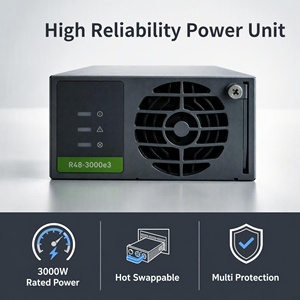
| Telecom Base Station / FTTH | 48V Hot-Swappable Rectifiers (e.g. R4850G, R48-3000e3) | Internal Closed-Loop Hall Transducer | 2,000W – 4,000W per module | High power density, continuous telemetry, hot-swap redundancy |
| EV Fast Charging Infrastructure | High-Voltage DC Power Modules (150-1000V DC) | Isolated Delta-Sigma Shunt Sensing | 20kW – 40kW scalable to 100kW+ | Wide output voltage range, dynamic current limiting, high efficiency |
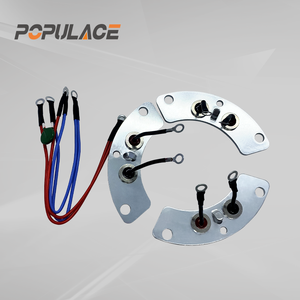
| Heavy Electroplating & Anodizing | Low-Voltage High-Current Rectifiers (POPULACE T30) | Busbar Current Shunt Transducer | High Amperage Continuous | Low ripple DC output, high thermal mass, corrosion resistance |
| Machine Building & Cabinet Control | Single/Three-Phase DIN-Rail AC/DC Supplies | Integrated Overload Sensing Circuitry | 10W – 2,000W | Compact rail footprint, wide input tolerance, high MTBF |
| Test Automation & Burn-In Labs | Programmable Variable DC Power Supplies | Digital High-Precision Current Sampling | 480W – 100kW | Remote CAN/Modbus programming, real-time voltage/current logging |
| Uninterruptible Industrial Control | Modular DC-UPS & Battery Charging Rectifiers | Bi-Directional Battery Current Monitoring | 480W – 105kW | Seamless battery buffering, temperature-compensated charging curves |
The global industrial power electronics market is experiencing structural transformations driven by electrification, green energy integration, and decentralized DC micro-grids. Procurement officers and B2B buyers must align their supply chain strategies with five core technology trajectories:
Traditional silicon MOSFETs are rapidly giving way to Silicon Carbide (SiC) and Gallium Nitride (GaN) switching components. For current sensor factories and rectifier exporters, adopting SiC enables operation at significantly higher switching frequencies (over 100 kHz to 500 kHz). This drastically reduces magnetic core dimensions (transformers and inductors), leading to a 30% to 50% decrease in overall module volume while maintaining exceptional conversion efficiency.
Analog status relays are being supplemented by digital communication buses (CANbus, PMBus, Modbus RTU). Modern 48V telecom rectifiers and EV charger modules stream high-frequency telemetry data including real-time current draw, thermal junction temperatures, input line quality, and capacitor degradation metrics. Procurement teams should prioritize factories offering software-configurable firmware interfaces that plug into central IoT monitoring dashboards.
Modern industrial plants are increasingly deploying local DC micro-grids operating between 450V DC and 820V DC to directly connect solar photovoltaics, battery energy storage systems (BESS), and regenerative motor drives. Direct DC-to-DC converters eliminate multiple AC-DC-AC conversion losses, improving overall factory efficiency by 8% to 12%. Direct factory sourcing of DC mini-grid DIN-rail converters is vital for modern energy-neutral facility builds.
As operating voltages increase in EV fast-charging networks and industrial energy storage, current transducers require enhanced creepage distances and higher isolation ratings (up to 5kV RMS). Hall-effect transducers and optical current sensors are built directly onto internal rectifier PCBs, eliminating the need for bulky external sensor wiring while guaranteeing noise immunity against high dv/dt switching transients.
Understanding internal current measurement physics is crucial when evaluating power supply vendors. Qualified current sensor factories typically deploy three distinct sensor topologies depending on dynamic performance requirements:
Operating Principle: Measures magnetic flux generated by current carrying conductors inside a magnetic core using a Hall IC.
Key Advantage: Low power consumption, low cost, small physical profile. Excellent for general industrial overload protection in standard AC/DC power supplies.
Operating Principle: Uses a secondary coil driven by internal amplifier circuitry to oppose the magnetic field generated by the primary current, maintaining zero net flux.
Key Advantage: Exceptional linearity, sub-microsecond response times, and near-zero temperature drift (<0.1%). Used in critical telecom rectifiers (e.g., Vertiv R48-3000e3) and precision laboratory supplies.
Operating Principle: Combines precision ultra-low resistance manganin shunts with optically or capacitively isolated digital delta-sigma modulators.
Key Advantage: Complete immunity to stray external magnetic fields, extremely high bandwidth, and high precision across high current densities (e.g., 133A EV power modules).
Key answers curated by senior power engineers to streamline specification reviews and vendor evaluations.
Consult with our senior application engineers to obtain technical datasheets, full compliance packs, custom voltage modification reviews, or direct OEM factory quotation pricing.
