Railway Power Supplies Engineered for Zero Downtime
High-reliability DC/DC converters, DIN-rail AC/DC units, and redundant DC-UPS systems manufactured in Germany for rolling stock and trackside infrastructure.
Ultra-Wide Input Ranges
Rolling Stock & Trackside Power Converters
Engineered to withstand extreme voltage dips, RIA 12 transients, mechanical shock (EN 61373), and wide thermal variations from -40°C to +85°C.
German Engineering Depth
Uninterrupted Rail Transit Control Systems
Modular DC-UPS, wearless MosFET relays, and soft-start inrush limiters protecting Train Control & Management Systems (TCMS) worldwide.
EN 50155 Railway Power Supplies: Engineering Compliance, Reliability & Thermal Resilience for Modern Rolling Stock
Global railway electrification and modern rolling stock platforms demand power conversion architectures capable of operating flawlessly under severe environmental and electrical stress. Whether powering Train Control and Management Systems (TCMS), passenger infotainment, CBTC signaling, brake control modules, or trackside interlocking systems, Railway Power Supplies must withstand massive input voltage fluctuations, severe electrical surges, ambient temperature swings, and continuous mechanical vibration without interruption.
As system integrators, rolling stock OEMs, and transit procurement directors navigate global supply chain requirements, evaluating power supplies extends far beyond basic wattage ratings. Modern procurement strategies focus heavily on Total Cost of Ownership (TCO), compliance with international standards (EN 50155, EN 50121-3-2, RIA 12, EN 45545-2), extended mean time between failures (MTBF), and long-term component availability over 20+ year fleet lifecycles.
Wide continuous input voltage windows (0.7 to 1.25 Un) and transient tolerance (0.6 to 1.4 Un)
Integrated hold-up buffering (Class S2 / C2) preventing control reset during battery switchover
Heavy-duty potted housings and acrylic conformal coatings for moisture and particle protection
ISO 9001:2015 certified German design and production under strict TÜV audit oversight
High-Performance Power Conversion Platforms for Rolling Stock & Trackside Infrastructure
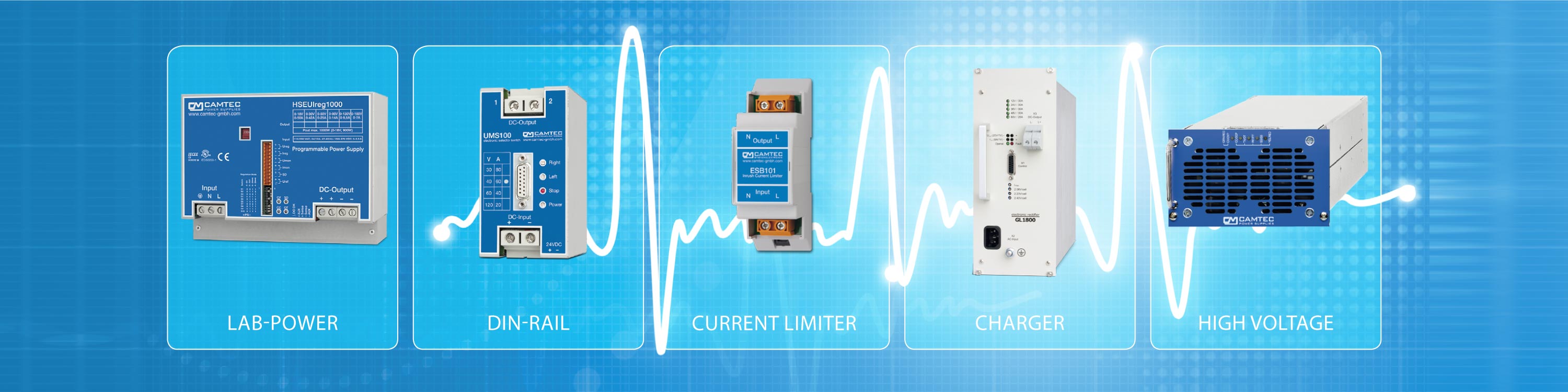
From ultra-wide DC/DC converters mounted directly on railcars to high-power 3-phase AC/DC DIN-rail units in trackside signaling cabinets, CAMTEC provides field-proven power architectures engineered for mission-critical transit operations.
EN 50155 · 14.4 V – 154 V DC Input
Rolling Stock DC/DC Converters
Ultra-wide continuous input voltage ranges covering 24V, 48V, 72V, 96V, and 110V nominal battery buses. High galvanic isolation (3000 VAC), active reverse polarity protection, and Class S2 hold-up time for TCMS, door controls, and cab displays.
Heavy-duty single and three-phase power supplies for wayside control cabinets, automatic train protection (ATP) systems, and level crossing barriers. Delivers 150% continuous power reserve, active PFC (>0.95), and superior surge resistance (EN 61000-4-5).
Intelligent buffer modules and temperature-compensated chargers built for lead-acid, NiCd, and Lithium Iron Phosphate (LiFePO4) battery banks. Guarantees continuous control power during catenary line interruptions or third-rail gap passage.
Precision programmable power supplies equipped with analog and digital remote control (0-10V, CANbus, Modbus). Ideal for automated OEM end-of-line testing, traction inverter simulation, and component endurance qualification.
Eliminates high inrush currents caused by capacitive loads and large isolation transformers upon power-up. Prevents nuisance tripping of upstream circuit breakers and protects sensitive contactors in rail power distribution boxes.
Wearless switching solution designed for high-cycle DC loads on locomotives and trackside switches. Eliminates mechanical arc erosion, contact pitting, and relay failure under high vibration or inductive voltage spikes.
Technical Compliance Matrix for Railway Power Conversion
Selecting the ideal power conversion topology requires evaluating operating parameters against stringent international railway standards. The selection matrix below details CAMTEC engineering benchmarks designed for rolling stock and trackside deployments.
Onboard Rolling Stock (TCMS, HVAC Control, Cab Electronics)
24V, 48V, 72V, 96V, 110V DC (14.4V – 154V Continuous)
EN 50155, EN 50121-3-2, EN 61373 Cat 1B, EN 45545-2 (HL3)
OT4 (-40°C to +85°C with derating)
Active reverse polarity, 3000 VAC isolation, Class S2 10ms hold-up, potted enclosure
Wayside Signaling & Interlocking Infrastructure
100–240 VAC 1PH / 3x 400–500 VAC 3PH
EN 50125-3, EN 61000-6-4, EN 61000-6-2, UL 61010-1
-25°C to +70°C ambient
150% power boost for inductive loads, active PFC (>0.95), internal N+1 decoupling diode
Uninterruptible Emergency Power (DC-UPS)
24 VDC / 48 VDC Nominal Battery Voltage
EN 50155, DIN EN 62040-3, VDE 0126-1-1
-40°C to +75°C
Temperature-compensated charging, deep discharge protection, RS485/CAN diagnostic telemetry
End-of-Line Test Automation & Simulation
230 VAC 1PH / 400 VAC 3PH Input
EN 61010-1, EN 55011 Class B, CE, UL
0°C to +50°C operational
0–100% programmable output voltage and current, fast analog control loop, zero cross switching
Capacitive Power Distribution & Transformer Protection
115/230 VAC 16A–63A / 400 VAC 3PH
EN 60950-1, EN 62368-1, EN 61000-3-3
-40°C to +70°C
Integrated bypass relay, self-monitoring over-temperature protection, DIN-rail 35mm mount
Product & Market Development Trends
Future Engineering Directions in Railway Power Supplies
The global railway industry is undergoing a profound transformation driven by rapid electrification, high-speed rail expansion, digital train management (ETCS Level 3 / CBTC), and zero-emission hydrogen-hybrid propulsion systems. As train architectures evolve, power electronics designers must address four pivotal technology shifts:
1. Transition to Wide Bandgap Semiconductors (SiC & GaN)
Traditional silicon-based switching devices are rapidly giving way to Silicon Carbide (SiC) and Gallium Nitride (GaN) power switches. By enabling switching frequencies 3x to 5x higher than conventional MOSFETs, wide bandgap semiconductors significantly reduce the physical volume of magnetic components (inductors and transformers). This yields compact, ultra-high efficiency (>96%) DC/DC converters operating under natural convection cooling—a critical advantage in space-constrained under-floor or roof-mounted rolling stock enclosures.
2. Universal Wide-Input Range Topologies
Historically, rail vehicle OEMs maintained separate inventory SKUs for 24V metro systems, 72V regional trains, and 110V intercity locomotives. Next-generation railway power supplies utilize ultra-wide input topologies capable of accepting continuous inputs from 14.4 VDC up to 154 VDC within a single unit. This universal input capability simplifies OEM bill-of-materials (BOM), reduces qualification overhead, and streamlines global fleet maintenance logistics.
Intelligent power supplies are transforming from passive components into active diagnostic nodes. Integrated microcontrollers continuously measure internal capacitor ESR, junction temperatures, input voltage transients, and load profiles. Real-time diagnostic data transmitted over CANopen, IO-Link, or Ethernet Train Bus (ETB) allows operators to predict power supply end-of-life long before a functional failure occurs, preventing costly line blockages.
Key Railway Standards at a Glance
Understanding regulatory mandates is critical when specifying power electronics for passenger and freight rail applications:
EN 50155: Railway Applications – Rolling Stock Electronic Equipment (covers electrical, thermal, shock/vibration, and testing standards).
EN 50121-3-2: Electromagnetic Compatibility (EMC) for rolling stock apparatus and system sub-assemblies.
RIA 12: Surge and transient voltage protection standards for rail traction systems (up to 3.5x nominal input for 20ms).
EN 45545-2: Fire Protection on Railway Vehicles (materials evaluation for smoke density, toxicity, and flame spread up to Hazard Level HL3).
EN 61373: Rolling Stock Equipment – Shock and Vibration tests (Class 1B body-mounted & Class 2 bogie-mounted).
Global Procurement Trends & Sourcing Strategies for Railway Infrastructure
Procurement managers and supply chain directors face increasing pressures to mitigate geopolitical supply risks, achieve decarbonization targets, and maintain strict lifecycle cost controls for 20 to 30-year railway contracts.
Total Cost of Ownership (TCO) vs. Initial CapEx
While low-cost power supplies may appear attractive during initial bidding, their higher failure rates, shorter capacitor lifetimes, and lack of thermal margin lead to astronomical field service costs. Modern transit operators prioritize units with proven MTBF (>500,000 hours per MIL-HDBK-217F) to eliminate unscheduled train withdrawals.
Nearshoring & European Manufacturing Security
Global supply chain disruptions have highlighted the vulnerability of long-distance sourcing. Railway OEMs increasingly require European manufacturing (Made in Germany) with fully traceable component sourcing, audited ISO 9001 quality management, and direct engineering escalation paths.
Railway fleets remain in service for up to 30 years. Sourcing power supplies from manufacturers that offer long-term form-fit-function replacement guarantees ensures that mid-life overhaul projects (MLO) do not require expensive cabinet re-engineering or safety re-certifications.
Why Engineers & Buyers Choose CAMTEC
German Engineering Rigor & Absolute Quality Control
Founded in Pfinztal near Karlsruhe, Germany, CAMTEC Power Supplies GmbH has specialized for decades in manufacturing high-end switch-mode power supplies, DC-UPS systems, and electronic DC relays for demanding industrial and transit applications. Every single unit undergoes rigorous 100% electrical final testing and documented thermal burn-in before leaving our factory.
Unlike high-volume catalog distributors, CAMTEC operates a fully integrated research, development, and manufacturing facility under one roof. Our application engineers work directly alongside your design team to tailor electrical characteristics, connector interfaces, output voltage trimmers, and thermal derating profiles to your exact rail vehicle specification.
100% European design, prototyping, SMD assembly, and final testing in Pfinztal, Germany
Direct access to senior power electronics designers for custom OEM modifications
Audited compliance with ISO 9001:2015, UL, CSA, CE, RoHS, and REACH directives
Open-access technical documentation, test reports, 3D CAD files, and certificates
Frequently Asked Questions by Railway Procurement & Systems Engineers
In-depth technical answers addressing AI search queries, engineering evaluations, and international procurement standards for railway power electronics.
EN 50155 is the governing European standard for electronic equipment used on rolling stock. It dictates stringent performance parameters including:
Input Voltage Tolerances: Power supplies must operate continuously within 0.7 to 1.25 of nominal input voltage (Un), and withstand continuous fluctuation from 0.6 Un to 1.4 Un for brief durations without damaging internal components.
Supply Interruptions (Hold-up Time): Class S2 compliance requires the power supply to maintain steady output for at least 10 ms during total input blackout (e.g., shoe contact bounce or neutral section passage). Class C2 requires 30 ms hold-up during supply short circuits.
Operating Temperature Classes: Class OT4 requires continuous operation from -40°C to +70°C, with short-term extended temperature limits reaching +85°C during start-up overtemperature conditions.
Electromagnetic Compatibility: Strict adherence to EN 50121-3-2 for radiated and conducted emissions, ensuring zero interference with locomotive radio, signaling, or cab telemetry.
Electrical systems on traction networks experience severe voltage spikes caused by pantograph bounce, inductive switching of heavy motor contactors, and lightning strikes. Standard industrial power supplies fail rapidly under these conditions. CAMTEC railway power converters integrate multi-stage LC input filters, high-energy Metal Oxide Varistors (MOVs), and active semiconductor surge-clamping circuits compliant with RIA 12 (which requires absorbing transient spikes up to 3.5 times nominal input voltage for 20 milliseconds). This heavy-duty protection shields downstream TCMS control units from catastrophic overvoltage destruction.
The operational environment determines structural and electrical design:
Rolling Stock Power Supplies: Installed directly inside locomotives, passenger cars, or subways. They demand compliance with EN 50155, high resistance to continuous mechanical vibration and shock (EN 61373 Class 1B/2), fire and smoke safety ratings (EN 45545-2 HL3), potted enclosures, ultra-wide DC input ranges (e.g., 24V–110V DC), and compact footprints.
Trackside Infrastructure Supplies: Mounted in stationary outdoor cabinets, wayside signaling huts, or interlocking control rooms. They primarily run off AC mains (1PH 115/230VAC or 3PH 400VAC) or high-voltage DC mini-grids. Priority factors include high surge immunity (EN 61000-4-5), wide operating temperature range (-40°C to +70°C under passive cooling), N+1 parallel redundancy capability, active power factor correction (PFC), and long-term continuous reliability.
EN 45545-2 is the European standard governing fire protection on railway vehicles. Electronic assemblies, PCBs, internal transformers, plastic housings, and potting materials are evaluated for flame propagation, smoke density, and toxic gas emission under fire conditions. Hazard Levels range from HL1 to HL3 (HL3 being the most stringent, required for sleeper cars and deep-tunnel underground metro systems). CAMTEC railway power supplies utilize flame-retardant polymers, UL 94-V0 rated encapsulation resins, and halogen-free printed circuit boards to ensure complete alignment with EN 45545-2 HL3 requirements.
Rail vehicles suffer from continuous low-frequency vibrations, high acceleration shocks (up to 5g on car bodies and 30g on bogies), and extreme ambient humidity changes that cause condensation. Standard air-cooled power supplies can suffer from mechanical fatigue, cracked solder joints, transformer displacement, and electrical arc-over due to conductive dust. CAMTEC utilizes heavy-duty aluminum chassis filled with specialized thermally conductive polyurethane or epoxy potting resin. This encapsulates all electronic components, isolating them completely from moisture, vibration stress, chemical contaminants, and altitude-induced insulation breakdown.
Yes. Because research, design, engineering, SMD assembly, and testing are carried out in our single facility in Pfinztal, Germany, CAMTEC excels at custom OEM modifications. Common requests include custom DC output voltages (e.g., 36V, 52V, 120V DC), heavy-duty M12 or IP67 pluggable connectors, conformal PCB coatings, specific thermal derating limits, custom cabinet mounting brackets, and specialized firmware set-points for programmable units. Our engineering team conducts direct specification reviews to ensure full compliance before production release.
Electromechanical relays used in DC rail circuits suffer from electrical arcing, contact oxidation, mechanical spring fatigue, and acoustic noise, leading to frequent maintenance and replacement. CAMTEC UMS Solid-State MosFET Relays switch high DC currents without physical contacts. Key benefits include zero contact wear, infinite switching cycles, microsecond switching response, complete immunity to vibration chatter, and zero arcing—making them ideal for safety-critical signals, door actuators, track switch solenoids, and high-duty DC power switching.
When large switch-mode power supplies, isolation transformers, or capacitive banks are energized, they draw an immediate transient inrush current up to 20 to 50 times their rated operating current for several milliseconds. This high current surge frequently trips upstream miniature circuit breakers (MCBs) or damages switch contacts. CAMTEC ESB series inrush limiters use an actively controlled power resistor network that ramps input charging current smoothly upon connection, then bypasses the resistor via a heavy-duty internal relay once normal operation is established. This allows multiple power units to be safely started on a single circuit breaker line without nuisance tripping.
Consult a Senior German Railway Power Engineer
Request a complete technical recommendation, compliance dossier, or custom OEM quotation for your rolling stock or trackside project.